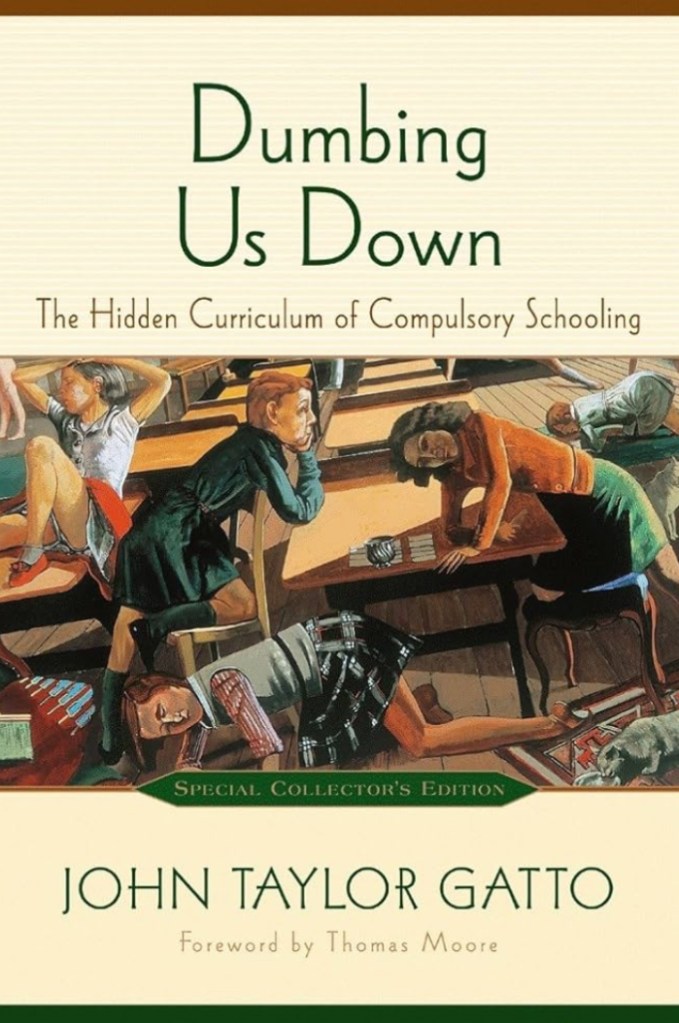
Dumbing Us Down by John Taylor Gatto offers a critical examination of the American education system. The book argues that mainstream schooling does more harm than good by stifling children’s creativity, discouraging independent thinking, and hampering intrinsic motivation, holistic growth and learning.
Short take: Written as a manifesto for change, this book provides a deep dive into the history, purpose and structure of conventional education. Taylor Gatto argues that mainstream schooling serves more to conform students to societal norms than to nurture their natural curiosity and growth. Originally published in 1992, the arguments made are still alarmingly relevant today and apply to schooling systems around the world. This is not a book for everyone, as it raises challenging points about the model of schooling that most of us accept as normal.
- Education and Parenting Approach:
- Dumbing Us Down advocates for a child-led, hands-on approach to education that prioritises curiosity, individualism and real world experiences.
- The parenting approach endorsed falls somewhere between authoritative and permissive parenting. It encourages parents to take an active role in their children’s learning, while providing them with space to experience the world without a parental helicopter.
- Key Themes:
- Failure of Compulsory Schooling: Taylor Gatto argues that mainstream education fails our children in many ways. The focus on rote memorisation and crystallised knowledge undermines children’s natural curiosity and intrinsic motivation. The behavioural approach taken teaches children to conform and follow orders, and is more about creating obedient workers than cultivating a lifelong pursuit of learning.
- The Role of Society in Education: Taylor Gatto suggests that societal structures and corporate interests play a significant role in shaping education, often leading to a system that benefits the economy rather than the individual.
- Alternatives to Traditional Education: He advocates for homeschooling or alternative schooling models that build practical, life long skills, harness critical thinking, and provide more scope for social emotional growth.
- Overall Impression:
- In Dumbing Us Down, John Taylor Gatto asks readers to rethink the purpose and effectiveness of mainstream education. He provides the historical backdrop in which schools were established, speaking about industrialisation, organised religion, and the drive to create an obedient workforce. He says that this schooling system no longer serves our children, and may in fact do more harm than good. Some of the detrimental effects outlined include stifling creativity, intrinsic motivation, and independent thinking in favour of compliance and rote memorisation. Taylor Gatto then offers alternative approaches to learning, such as homeschooling and alternate schools that nurture independent thought and prioritise real-world experiences.
- Originally published in 1992, the core thesis of this book is still alarmingly relevant today, so much so that many may argue not much has changed in the way we approach education.
- Overall, I found this book an eye opening read. It was one of the first books I read that made me seriously rethink how I would educate my own children. His arguments made me reflect on how I could nurture my girls innate drive to learn and explore the world. This is not a book for everyone, but is a worthwhile read if you’re willing to step outside the mainstream paradigm and challenge a very engrained way of thinking about education.



Leave a Reply