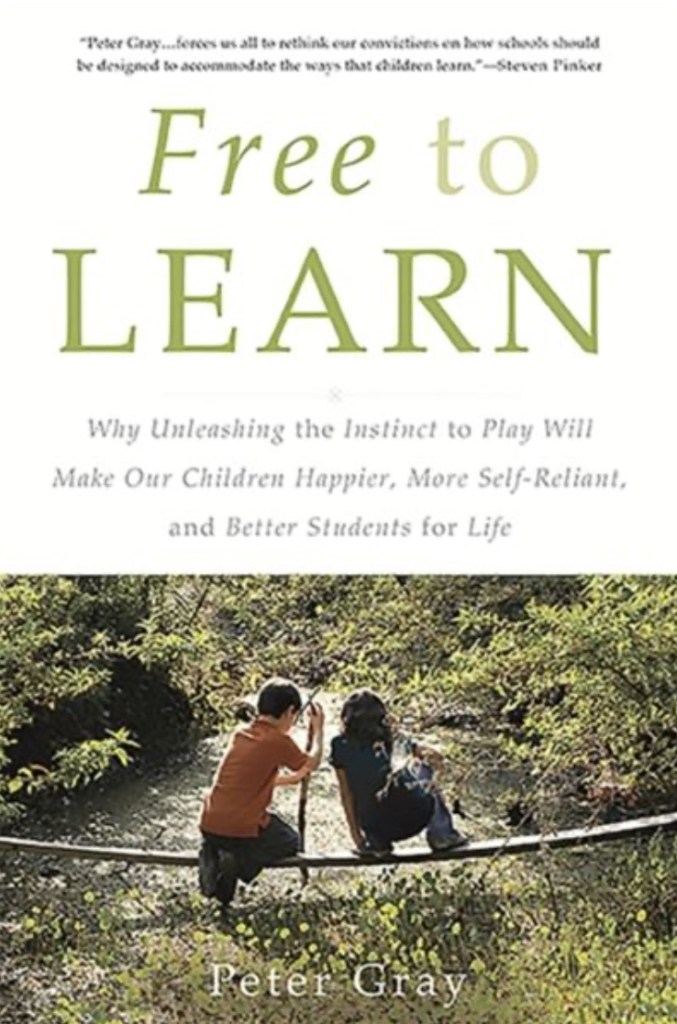
In ‘Free to Learn’, Peter Gray explores the benefits of natural, self-directed learning and provides a compelling argument against the traditional schooling system. One of the most well researched books I have read to date, it is difficult to give this book anything but 5 stars.
Short take: The book advocates for a paradigm shift in our education system, towards an approach that prioritises autonomy, play and curiosity in fostering more independent, intrinsically motivated learners. It lays a strong case for an alternate to mainstream schooling. The book unexpectedly and radically shifted my views on education and perhaps most tellingly, how I will educate my own girls. Expect an exciting and, at times, unnerving read.
- Education and Parenting Approach:
- ‘Free to Learn’ advocates for a child-centred, holistic approach to education and parenting, prioritising autonomy and self-direction over more controlling, didactic, and authoritarian methods.
- The book challenges traditional notions of schooling in which children must follow a set curriculum and adhere to strict rules. These methods often override children’s innate interests and compromise their intrinsic motivation, curiosity, creativity, and overall learning.
- Key Themes:
- The Role of Free Play: Gray highlights the essential role of play in children’s development, arguing that it is through play that children learn skills in problem-solving, critical thinking, and decision-making. Play teaches children cooperation, communication, and empathy, allows children to express themselves creatively, and provides a safe space to practise regulating their feelings. Play is not only enjoyable but essential for holistic learning.
- The Importance of Freedom: The book advocates for giving children the freedom to explore, make choices, and learn from their experiences, emphasising the value of autonomy and intrinsic motivation in education.
- Critique of Traditional Schooling: Gray critiques the traditional schooling system for its emphasis on conformity, rote learning, and standardised testing, which he argues stifles children’s natural curiosity and motivation. By prioritising academic achievement over holistic development and delivering prescribed curricula, schools may overlook the unique interests and learning styles of individual children, leading to disengagement, boredom, and a lack of enthusiasm for learning.
- Unschooling and Self-Directed Learning: Gray explores the concept of unschooling, where children learn through pursuing their interests and passions rather than following a structured curriculum. He presents evidence of the effectiveness of self-directed learning and the positive outcomes it can have on children’s academic achievement and personal development.
Overall Impression
- ‘Free to Learn’ draws on psychological, anthropological and educational research to advocate for an alternate approach to schooling, asking readers to seriously consider whether mainstream schools are the best way to educate our kids.
- Athough Gray argues for a radical shift in our education system, I think there are ways of integrating the principles he proposes that would greatly benefit children, in and out of mainstream schools. Things such as favouring autonomy over control, creativity and independent thought over rote learning, and a more individualised approach to learning over standardised curricula.
- The book details the historical and cultural reasons that mainstream schools were established, highlighting how outdated and irrelevant this system is today. It explains how the rise of industrialisation, combined with the influence of the Church, created a demand for a disciplined and skilled workforce and prompted the establishment of mass education to meet these needs. This traditional model of schooling, characterized by rigid rules, authority figures, disciplinary measures, rote learning, standardised testing and a hierarchical structure, offers a one-size-fits-all approach that does not serve modern children well.
- Gray expands his critique arguing that the hierarchical structures in schools can undermine children’s autonomy, sense of agency, and responsibility for their own learning. By prioritising compliance and uniformity over creativity and exploration, schools may inadvertently hinder children’s intellectual curiosity and emotional wellbeing. Finally, outdated learning materials offer little real world application of knowledge, which ultimately fails to prepare our kids for the complexities of the modern world.
- The book then offers an alternate to this old world system that focuses on personalised learning and student centred pedagogies. Such a model would better prepare children for the types of jobs they will have in a digital, post-industrialised age. These jobs will require innovation and invention, development of new technologies, and an ability to work independently in remote working environments. Children with skills such as flexibility, creativity and autonomy are likely to thrive, while others may be left behind.
- This book radically and unexpectedly shifted my views on mainstream education and schooling. I experienced a degree of cognitive and emotional dissonance while reading, as the arguments Gray puts forward about natural learning are unequivocally true, yet challenged my beliefs and personal experience of school. The information made me reflect upon my clinical experiences with teenagers, in which not one young person has told me that they feel they are learning to their fullest potential at school nor that the approach is personally right for them. Why, I then asked myself, aren’t we listening to what these young people are saying? Likewise, I encourage you to think about how much of the knowledge and skill base you use from day-to-day you learned at school?
- I encourage all parents and educators to read this book, least to gain knowledge about how to support your child’s learning best.
2 responses to “‘Free to Learn’ by Peter Gray”
-
so very true traditional school tends to stifle the free and creative minds of children. I’m in a constant tug of war with myself when it comes to my children’s education “they should know this” “should be further ahead” I then have to remember I’m still unlearning the years of traditional schooling I had as a child and young adult. Encouraging them in their interests and not confining them to societies educational expectations.
-
A great set of guiding principles to reffer to whether children are in mainstream or non mainstream education, to encourage reflection on our own unconscious bias towards children and our conditioned expectations for their development both academically and socially.
Too often schools/Early Education Centre’s become fanatical and over subscribed to their own pedagogy alienating children who dare to wonder outside of the framework and challenge the boundaries for their unique self development.
This book looks excellent. Look forward to reading!
LikeLike




Leave a Reply