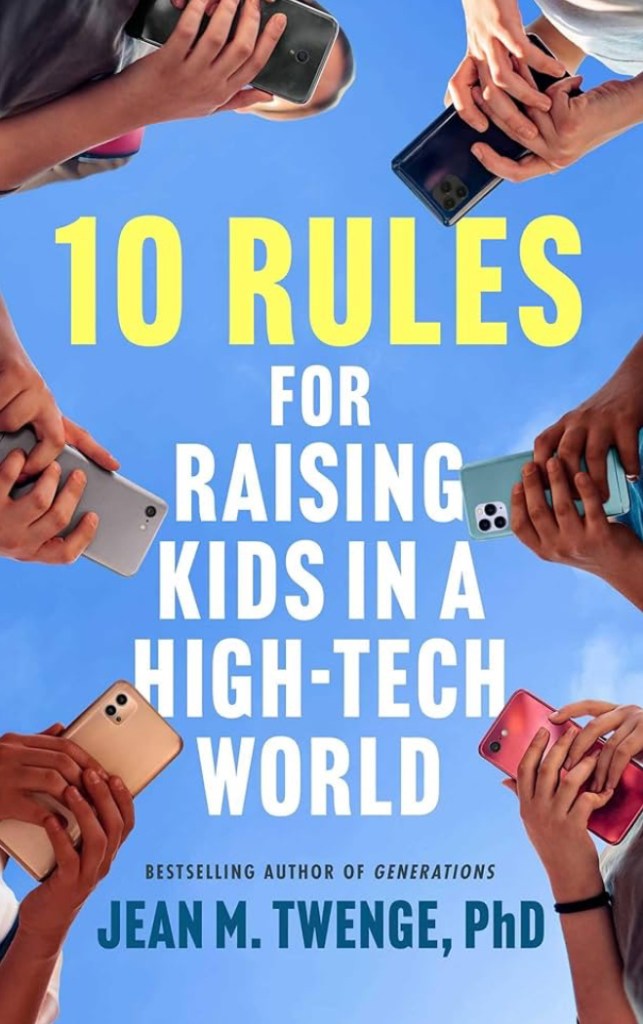
Newly published in September 2025, Jean Twenges latest book offers up clear, practical, and actionable advice for parents navigating technology and social media use with their tweens and teens.
Short Take: The 10 rules proposed focus on setting clear, early rules around devices; delaying access to smartphones and social media until 16 or later; creating tech‑free spaces and times; modelling healthy use of technology as a parent; and promoting real world freedoms that equip children with skills for long‑term independent flourishing, rather than aiming for short‑term screen-time management. At the heart of her thesis is that parents must take charge, reasoning that kids can and should not be expected to have the maturity or capacity to enact these guidelines alone – indeed, many adults struggle setting these limits themselves.
Parenting Approach:
- Twenges parenting approach is authoritative, encouraging validation and communication alongside boundaries and rules. Twenge uses the metaphor of “dolphin parenting” (as opposed to “fish”, “sea‑sponge”, or “tiger shark” parenting, which describe uninvolved, permissive, and authoritarian styles, respectively) to describe an ideal of balancing consistent boundaries with emotional support; a firm but flexible approach.
- Twenge encourages parents to explain the “why” behind rules at an age‑appropriate level, and to model the digital habits that they would like to see in their child.
Key Themes:
- Rule 1. You’re in charge. The first and most important rule is that parents must establish or reclaim authority over device and screen use. Twenges thesis is that letting kids decide on their screen time is not reasonable, realistic or fair.
- Rule 2. No devices in the bedroom at night. Banning devices in bedrooms at night, setting consistent bedtimes, and recognising how blue‑light/screen stimulation erodes rest.
- Rule 3. No social media until age 16 or later. One of the major prescriptions is to delay giving children social media (and ideally smartphones) until age 16 or older, and enacting age‑appropriate stepping‑stones prior to this. Early and excessive screen use is said to pose risks for self-esteem, peer relationships, mental health, and cognitive functions such as working memory and distractibility.
- Rule 4. First phones should be basic. Getting a basic “flip phone” or “dumb phone” is recommended, allowing kids to make calls and send messages without access to the internet or apps.
- Rule 5. Give the first smartphone with the drivers license. This rule is just as it sounds, delay the first smartphone until teens have their driving license.
- Rule 6. Use parental controls. Parental controls allow parents to limit screen time, block certain apps or sites, and monitor device use. They can be downloaded onto phones, streaming services, and gaming consoles.
- Rule 7. Create no phone zones. Designate “no‑phone zones” (eg. bedrooms, night time, family‑meals) so devices don’t dominate all parts of life. This rule may help protect sleep, face‑to‑face social interactions and boundaries around screen time.
- Rule 8. Give kids real world freedoms. As with the thesis offered up in Free Range Parenting, children need real world (age-appropriate) responsibilities and independence, such as riding bikes, walking or catching public transport in safe, local areas. The focus is on safe unsupervised time to explore and make choices.
- Rule 9. Beware the laptop – and the gaming console, and the tablet, and… Screens beyond phones carry risks too – gaming consoles, tablets, and laptops can equally negatively affect sleep, blur boundaries, and allow unhelpful, online interactions. Twenge urges awareness and rules for all devices, not just phones.
- Rule 10. Advocate for no phones during the school day. Phones during school can distract, reduce face‑to‑face interaction, and impede learning. Twenge encourages parents and schools to work together.
Overall Impression:
- The overall thesis of this book is that parents must take a deliberate, firm and boundary‑setting approach when it comes to screens. The ten rules proposed form a coherent framework that emphasises clear, early, family-based rules, and parental guidance and control.
- The book starts with a chapter outlining research findings pertaining to mental health and social media use among kids and teens. Some alarming yet necessary facts are stated, such as that rates of depression and loneliness have been steadily rising since 2012; that in 2022, the percentage of US 10th and 12th graders getting at least 7 hours of sleep each night was below 50% and 40%, respectively; and that teens who are heavier users of technology (including online gaming, internet use, online videos, and social media) are 30% to 200% more likely to be depressed or unhappy.
- Twenge doesn’t stop with the doom and gloom of the research, instead offering hope and a path forward for parents. A chapter is dedicated to each rule, discussing how to implement it and the reasons that it is important.
- Twenge is firm and unyielding in her advice, which some readers might find overly strict or difficult to enforce. For instance, delaying smartphones until 16 and/or tightly controlling device access is undeniably challenging when teens are saying that all their friends have something else, but Twenge urges parents to have sustained willpower and conviction in their decision. She argues that failing to endorse these rules could have dire consequences for social, emotional and physical wellbeing.
- Overall, this book is an informative, timely, and well written book. Suitable for anyone grappling with questions like: “When do I give my child or teen a phone?”, “How do I stop social media messing with my child’s friendships, self esteem, and mood?”, or “How do I ensure my child still has real life friends, independence, and sleep?” Read if you feel inclined, although a summary or review may be just as informative.






 Child Psychology Book Lady
Leave a comment