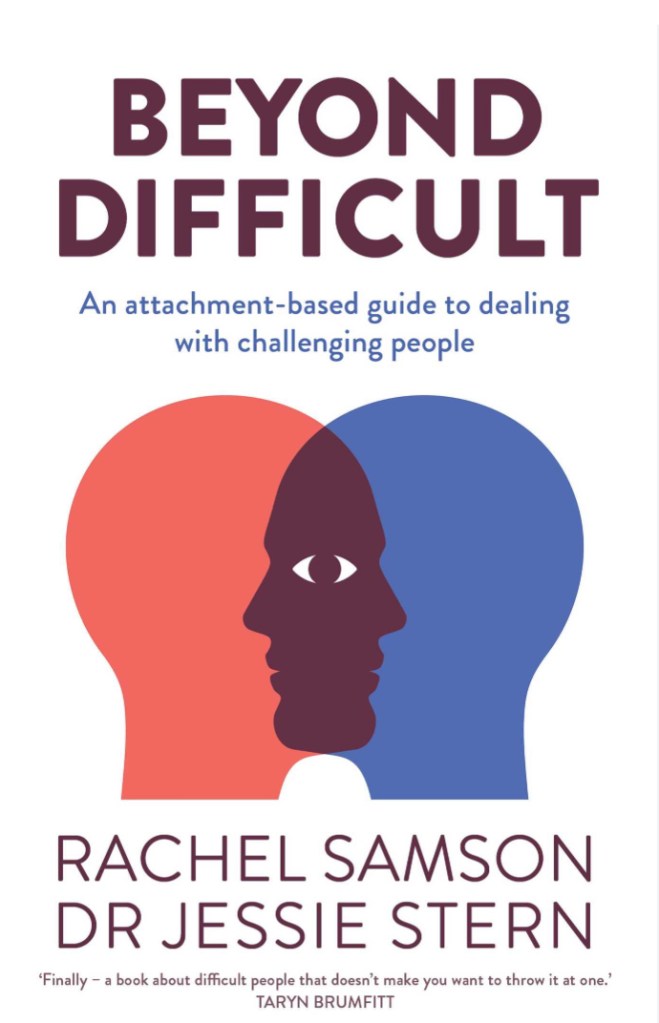
Newly published in June 2025, Beyond Difficult is a neuro-affirming, attachment based guide to developing and maintaining satisfying and secure relationships, whether that be with a partner, colleague, friend or child.
Short take: This book offers plenty of practical strategies for dealing with “difficult” people, focusing on self-reflection, insight, and empathy over pathologisation and blame. It encourages readers to reflect on their own attachment styles and relational schemas, to strengthen self-regulation and communication skills, and to know when a relationship is worth pursuing and when to step away.
Parenting Approach:
- Beyond Difficult is not a purpose written parenting book, but offers plenty of practical strategies for responding to children or a partner who may feel “difficult”. It encourages connection before correction, co-regulation, predictability, safety, and cultivating environments where a child or partner has the freedom to develop into their authentic self.
- The approach is neuroaffirming and attachment-based. It normalises and validates difficulties, rather than placing pathology within the child. A specific chapter is dedicated to people with Autism, ADHD and giftedness.
Key Themes:
- Embracing Neurodiversity. The authors acknowledge that people with Autism, ADHD, giftedness, epilepsy and other neurdiverse conditions are often more difficult to interact with. Rather than blaming these individuals, they highlight the double empathy problem: that neurotypical and neurodiverse people both have difficulty taking the perspective of one another.
- Relational Schemas. Schemas are relational imprints from our early attachments with caregivers that affect the way we relate to others and ourselves as adults. The authors provide a detailed description of schema modes (e.g. vulnerable, angry or impulsive child, happy child, punitive parent, and healthy adult), and ways to step into healthy adult more easily and often.
- Emotion Regulation. Some of the self-regulation strategies offered include breathing, thought challenging, exercise / movement, self-talk, connecting with nature, physical touch, and reaching out to social supports.
- Thinking Errors. Also called Cognitive Distortions, these are patterns of thinking or ways that we interpret situations, which affect our feelings and behaviour. The authors offer basic strategies to identify and challenge these thoughts.
- Relational Red Flags. The Gottman Method is drawn upon to discuss red flags in communication that purportedly predict divorce at a rate of 80-90%. These include criticism, contempt, defensiveness and stone walling, as well as a fifth factor of how successful attempts to repair conflict are.
- Communication and Interpersonal Skills. The authors offer a detailed discussion of healthy communication skills, focusing on both verbal and non-verbal cues, limit setting and boundaries, and the value and art of giving feedback.
Overall Impression:
- Beyond Difficult: An Attachment Based Guide to Dealing with Challenging People is an accessible and compassionate guide to dealing with people who may feel frustrating, overwhelming or hard to reach. The core thesis is that difficult interpersonal interactions are a part of all of our lives, what we perceive to be difficult is subjective and bound up in our own relationship histories and schemas, and that there is a path to improved communication and relational repair.
- The book touches on behaviour that may feel passive, permissive, controlling, avoidant, people pleasing, or aggressive. It says that these behaviours are often present in people with insecure attachment styles. Rather than pathologising or blaming, it encourages empathy and perspective taking, and a route to repair relationships after a rupture. Nevertheless, the authors are pragmatic and sensible, acknowledging that sometimes stepping away from a relationship with a difficult person is the best approach.
- Plenty of practical strategies are offered throughout the book, aimed at improving emotion regulation, insight, communication, limit setting/boundaries, and the ability to step into “healthy adult” mode. These mainly stem from Cognitive Behavioural Therapy (CBT), Schema Therapy and Mindfulness practices.
- One criticism I have of this book is the slight over-emphasis on the role of early attachments with caregivers, rather than discussing broader contextual, societal, and relational factors that contribute to how we are with others. This is a limitation of many modern self-help books, which rely overly on Western psychological frames.
- Overall, this book is an easy read that offers a pathway to having more secure and satisfying relationships. The overarching message – that relationship difficulties are inevitable, that we cannot control others but we can transform how we meet them through empathy, compassion, and connection – is hopeful and empowering. Most suited to people seeking an introduction to psychological and relational concepts, and practical strategies to improve their relationships with others and themself.




 Child Psychology Book Lady
Leave a comment