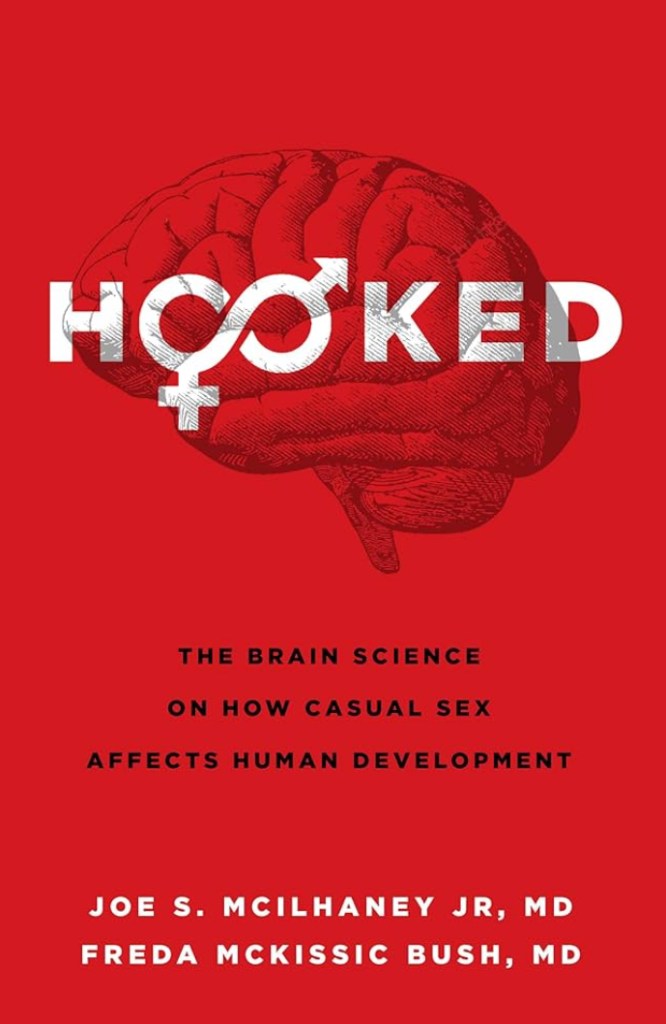
‘Hooked’ offers a succinct and pointed exploration of the intersection between neurobiology, bonding and sexual partners. The authors argue that casual sex can have negative long-term effects on attachment and relationship stability. They encourage parents and young people to aspire to have just one sexual partner in a lifetime.
Short take: The authors of this book argue that casual sexual encounters can irreversibly alter our brain’s bonding and reward systems, effecting the release of oxytocin and dopamine. While the emphasis on monogamy and abstinence may not resonate with many readers, their arguments are thought-provoking and may serve as a useful starting point for discussion.
Parenting Approach:
- The parenting approach taken in this book is somewhat conservative and authoritarian. The authors advocate for monogamy and encourage parents to advocate for this approach with their children.
Key Themes:
- The neuroscience of bonding. The book explains how brain chemicals like oxytocin, dopamine, and vasopressin influence emotional attachment. The authors claim that repeated sexual encounters with different partners can fundamentally alter the way the brain forms lasting bonds.
- Emotional and psychological consequences. The authors link casual sex to emotional distress, depression, and difficulty in forming stable relationships. They say that sexual activity outside of committed relationships can be psychologically harmful, especially for teenagers, arguing for one sexual partner in a lifetime.
- Role of culture and social media. The book critiques modern attitudes toward sex, suggesting that cultural messages downplay the risks of casual relationships while ignoring the emotional and neurological impact.
Overall Impression:
- Hooked explores the neurological and emotional effect of casual sex among young people. The authors, both medical doctors in obstetrics-gynaecology, sexual health and women’s health, argue that having multiple sexual partners can alter biochemical bonding pathways, having long-term consequences for emotional wellbeing and relationship stability.
- The book challenges prevailing socio-cultural norms that normalise casual sex. They say that mainstream culture has gone too far, conveying a sense that those who choose to abstain from sexual intercourse, or to have just one partner, are missing out on an important milestone or rite of passage. This could be alikened to the culture of teen binge-drinking that has prevailed in many Western countries.
- For parents, the book serves as a cautionary guide. The authors promote abstinence and monogamy as the healthiest choices for young people. While some parents may appreciate this perspective, others may find the lack of discussion on safe sex education and different relationship models limiting.
- Critics of the book have raised concerns about its moralistic undertone, conservative viewpoint, and selective use of research. Some say it does not fully explore counterarguments or alternative perspectives on sexual health.
- Overall, this is worthwhile read for anyone interested in the intersection of neuroscience and sexual behaviour. The heavy emphasis on abstinence may not resonate with many readers, however, it could still serve as a useful starting point for discussion. As always, parents will benefit more by supplementing this book with other resources that offer diverse perspectives.




 Child Psychology Book Lady
Leave a comment