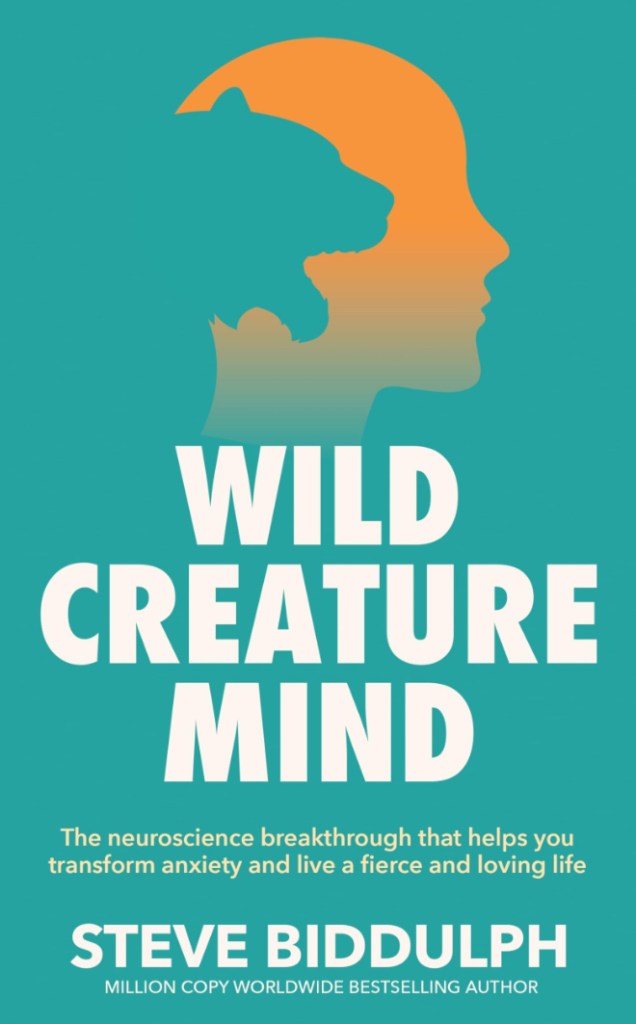
‘Wild Creature Mind’, the latest book by Steve Biddulph (author of ‘Raising Girls’, ‘Raising Boys’, and ‘The Secret of Raising Happy Children’) offers an intriguing dive into role of right hemisphere processes in emotional awareness, holistic wellbeing, and psychological healing.
Short Take: This book encourages readers to harness and nurture their ‘wild creature mind’ – the right hemisphere of the brain, often overlooked in favour of verbal, left-brain processes. It refocuses our attention on intuition and felt sense, as powerful ways to navigate change, emotional hardship, and everyday ups and downs. Offering practical strategies along accessible and digestible information, this book has something to offer for both personal growth and parenting awareness.
Parenting Approach:
- This book is a not a purpose written parenting book, but a holistic approach to emotional wellbeing for adults and children alike. Nevertheless, it offers strategies that can be applied to raising kids and has a chapter dedicated to children.
- Biddulph is widely recognised for his existing parenting books – ‘Raising Boys’ and ‘Raising Girls’. His approach is authoritative, combining structure and containment with emotional warmth and responsiveness.
Key Themes:
- Connection to intuition, instincts and felt sense: Encourages readers to tune into their right hemisphere or intuitive side, and teaches children to do the same.
- The role of community and family ties. Biddulph points out that humans have historically lived in communities and clans, and that the modern siloed approach to living goes against our instincts and needs. He discusses how much is to be gained from multi-age living, learning, and companionship.
- Debunking myths about left vs. right brain processing. The book addresses three myths about the left and right hemispheres of the brain, namely that: 1) the left is rational and the right is emotional (truth: the left is verbal but still prone to suggestion and persuasion. It is not all logic), 2) the left is masculine and the right is feminine (truth: a gendered approach to the brain is neither accurate nor helpful. The hemispheres work in an integrated way), 3) the left is for thinking and the right for feeling (truth: thinking and feeling are managed by both sides of the brain).
- Focusing as a strategy to access felt sense. Focusing is introduced as a therapeutic strategy to get in touch with right-hemisphere processes. Biddulph argues that focusing can be used to gain insight, access feelings that are being held in the body, or become clearer in ones needs or wants. Focusing involves paying attention to one’s internal bodily state while maintaining a non-judgemental and curious stance.
- Tremoring as a strategy to release bodily emotions. A therapeutic strategy that involves allowing the body to shake or tremor. Biddulph explains how harnessing this spontaneous, healthy and natural response can down-regulate the body, shake off anxiety, and release trauma held in the body. He describes Tension & Trauma Release Exercises (TRE) that readers are encouraged to try.
- Dreams. The book discusses how to make sense of and work through dreams and nightmares using felt sense.
Overall Impression:
- In this clear and engaging book, Steve Biddulph blends evolutionary neuroscience with storytelling and practical exercises and encourages readers to lean into their ‘wild creature mind’. He discusses the importance of right hemisphere processes – gut instincts, intuition, or felt sense – in achieving emotional understanding, psychological healing, relational awareness, and holistic wellbeing.
- Biddulph offers practical exercises to help readers feel into their bodies. The goal of these activities is to access a more primitive and less verbal form of innate knowing, which he says is the basis of emotional healing and growth.
- One of the more unconventional techniques the book discusses is ‘tremoring’- a somatic exercise that harnesses the bodies natural reflex to shake or shudder when under stress. Therapeutic tremoring is used as a way to release tension or trauma and to down regulate the body. Biddulph describes the technique as euphoric or similar to orgasm, and recounts transformative personal experiences of releasing emotions and unlocking childhood memories that he wasn’t even aware were present.
- I enjoyed the simplicity and accessibility of the chapter dedicated to children. Strategies offered include helping children label feelings with a colour, shape and form, to locate feelings in specific body parts, to use drawing and movement to work through emotions, and to sit with feelings until they pass. By combining language, words and storytelling with felt sense, the book shows parents how to help their child’s right and left hemispheres talk to each other, thus achieving emotion regulation and greater stability of self.
- Overall, I found this book balanced, insightful and helpful. I enjoyed each and every chapter and was surprised and excited by the journey Biddulph took me on as the reader. This is an excellent read that provides scope for both for personal growth and parenting awareness.




 Child Psychology Book Lady
Leave a comment