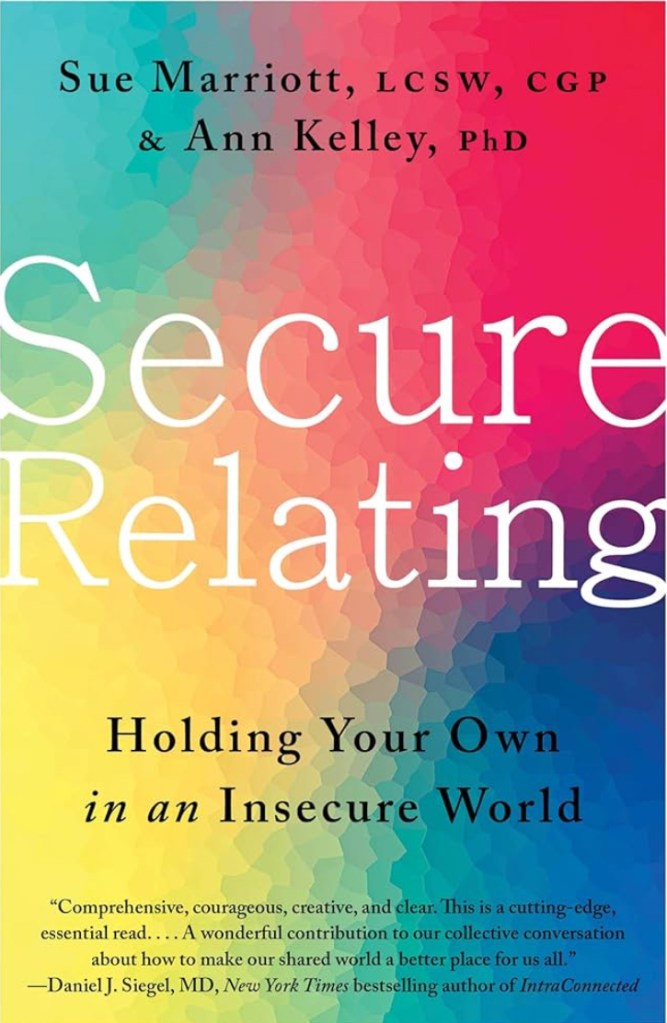
One of the most comprehensive, concise and insightful books I have read in a while, ‘Secure Relating’ offers a roadmap towards fostering healthier and more fulfilling relationships, whether that be with our children, partner, or peers.
Short Take: This book explores the role of our individual histories, as well as collective wellbeing and systemic injustices, in shaping how we relate to one another. It sends a hopeful and empowering message that it is possible to work towards satisfying and secure relationships irrespective of early attachments and relationship history. Full of wisdom, Marriott and Kelley have absolutely nailed the balance of theory and practical guidance in this book.
Relational and Parenting style
- Marriott and Kelley advocate for an empathetic and responsive parenting approach, encouraging caregivers to attune to their child’s emotional needs while providing a safe and supportive environment for growth.
- Their relational approach is closest to an authoritative style of parenting, in that it emphasises both emotional validation and containment.
- A significant part of their approach is encouraging readers to explore their own emotional reactions and triggers through insight-oriented therapy, self-reflection and self-care, and work to improve self-regulation through cultivating a secure state of mind.
Key Themes:
- Secure Relating vs. Secure Attachment. The authors distinguish between secure attachment and secure relating, which they aptly point out are often confused with one another. Whereas secure attachment refers to the early bond we form with a primary caregiver, secure relating is a variable state in how we relate to and connect with others throughout our lives. When relating securely, we can express feelings and needs while taking into consideration those of others. We have empathy and compassion, can communicate effectively, have confidence and trust in others, and are able to be flexible while maintaining boundaries and self-respect. This is a state that we all naturally shift in and out of, and can cultivate in relationships throughout our lives. It is not the same as secure attachment, although having a secure early base can make secure relating easier.
- Healing and Growth. The book acknowledges the potential for healing and growth in our interpersonal lives, providing guidance and hope in being able to establish secure connections with others irrespective of trauma, difficult early attachments and relationship history.
- Self awareness. The book encourages parents to engage in self-reflective practice, examining our own attachment histories and parenting patterns as a way to promote self-awareness and growth. By fostering a reflective stance, the authors say that we can regulate our emotions more easily, making it easier to navigate the inevitable interpersonal challenges that arise with our children, partners, family and friends.
- Socio-Cultural and Systemic Factors. The book details how societal factors may hinder relational security, such as systemic racism, marginalisation, micro-aggressions, and discrimination that is ingrained in social structures and institutions. The authors encourage individuals from marginalised communities to consider whether there are any real or current threats that are causing them to relate defensively before self-pathologising or pinning relational difficulties to early attachments.
Overall Impression
- Drawing on attachment and neuroscience literature, as well as decades of collective clinical experience, this book offers a compassionate and evidence-based approach to understanding our relationships and provides a path to improving them. The authors outline a simple model that explains how and why we relate to others the way we do, explaining why we can have positive and healthy relationships with some people and more defensive or challenging relationships with others.
- The central tenant of the book is that of secure relating, defined as a mental state in which we are able to relate in a healthy and emotionally regulated way. Secure relating is characterised by being aware of ourself and another person, by thinking and feeling, by self-regulation and self-awareness, and by receptivity to our own and another person’s needs. In a secure state of mind, we can take on board feedback constructively and work through difficulties rationally while still being in touch with our feelings. It is normal and expected to shift in and out of this state from day-to-day, and we may still experience difficult emotions while relating securely, but can generally maintain our thinking and act in a calm, considered way. This concept is similar to the notion of Wise Mind in Dialectical Behaviour Therapy (DBT).
- One thing I loved about this book was that it appeals not only to individual psychology, but to our collective and communal ways of relating to one another. The authors take a systemic, cross-cultural and progressive stance, discussing how current social threats, systemic injustices, and prior relationships affect how we relate. It moves us beyond a discussion of early attachments to our parents. In this way, it does not pathologise or blame, but provides hope and empowerment, especially for those with a history of trauma and/or from marginalised groups.
- I found this book to be concise, comprehensive and full of wisdom. A must-read for anyone interested in deepening their understanding of themselves and others, cultivating empathy, and fostering healthier relationships in their lives.
Learn more: Marriott and Kelley have a podcast titled ‘Therapist Uncensored’ and discuss the book across 2 episodes on 30 April & 7 May 2024.






 Child Psychology Book Lady
Leave a comment