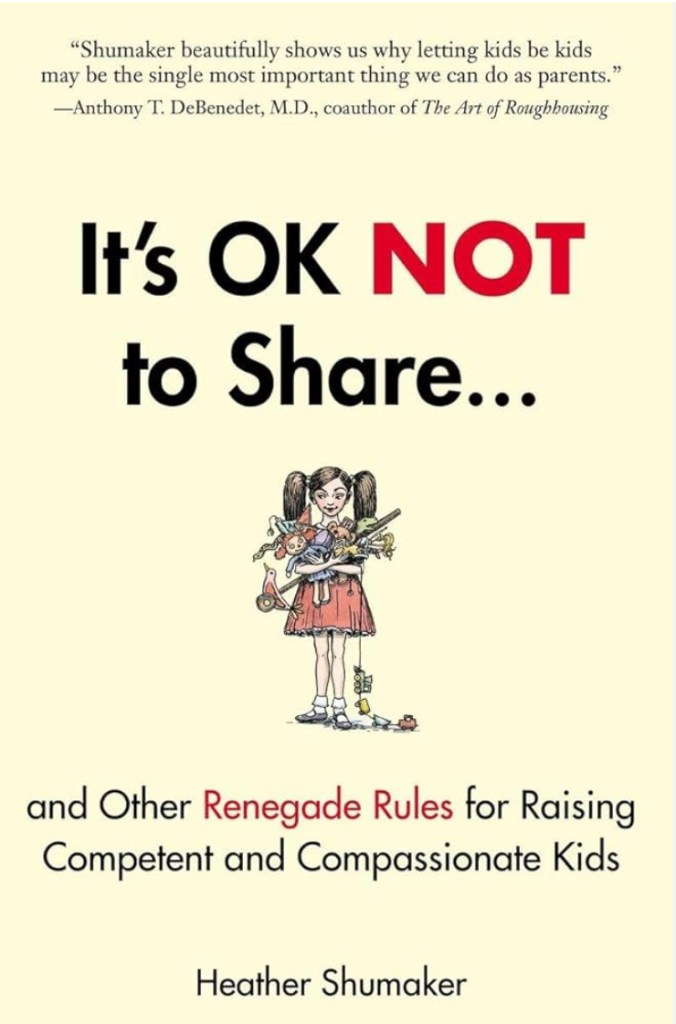
‘It’s Okay Not to Share’ aims to provide parents with a set of 29 “rules” for raising kids. Pitched at parents of 4 to 6 year olds, the fundamental principles are positive yet the book falls short in how they are applied.
Short take: The title and chapter overviews for this book sounded promising and progressive, yet the book left me feeling disappointed, frustrated, and resigned. While trying to be child centred, the parenting approach is authoritarian at its core. Overall, I think there are better ways to foster happy, social, connected, and contained kids, and suggest skimming the chapter titles but don’t waste time reading further.
Parenting Approach:
- Shumaker describes a parenting style that strives to be child-centred, yet is reminiscent of authoritarian practices of the past. The approach reflects a Western parenting frame.
- The core principles that the book endorses are worth reading, and by skimming the index, parents will gain most. Some of the key themes explored are listed below.
Key Themes
- Allow Spontaneous Free Play
- Feelings Are for Feeling
- No Hurry, No Worry
- Get Comfortable with Chaos
- Ditch Competition
- Problem Solving Is a Process
- Get Physical
- Respect Uniqueness
- Create Community
- Choose Compassion
- Empower Through Empathy
- Respect Nature
- It’s OK to Start Over
Overall Impression:
- ‘It’s Okay Not to Share’ offers 29 “rules” to help parents of preschool and early primary school age children. These rules are summarised by the author in one overarching rule: “If it’s not hurting people or property, it’s okay”.
- The approach offered seems to be grounded in the author’s own experience of parenting, her mother’s experiences as a teacher, and her Christian faith. In this way, it does not offer an overly transferable or culturally sensitive approach. Some of the strategies offered may have a place if the goal is short-term behavioural compliance in a classroom setting.
- The principles proposed are unarguably positive and what led me to read the book in the first place. Themes such as the importance of free play, fostering empathy and perspective taking, allowing opportunities for conflict resolution, participating in community, and respecting each other and nature. Unfortunately, as the author expands upon each rule and gives examples of how it can be applied, she moves further and further away from its essence. Each chapter loops back to an approach that advocates for adult control over child-led activities (while touting the opposite) or leaves children completely to their own devices. This wavering between hands-off and very hands-on parenting is typical of an authoritarian style.
- One issue I had with this book is that the author contradicts herself throughout. For instance, she discusses the importance of spontaneous free play, before stating the innumerable ways that parents can and should restrict play. Another example is allowing kids to resolve conflicts without adult intervention, before outlining 10 steps for parents to mediate conflict with kids. Neither of these stances seem balanced or like the best approach, and may create unnecessary division between adults and kids, leaving little room for intergenerational, bidirectional learning.
- I also found the book to be overly directive, offering statements and step-by-step plans that parents can use at home. While struggling parents may appreciate this initially, this approach rarely improves a parent’s competence or confidence in the longer term, and can actually undermine their innate knowing and capacity to respond spontaneously. Furthermore, some of the strategies suggested (eg. getting a written contract from a child to confirm that they will not do something again) are outdated and highly unlikely to be effective. Perhaps not surprisingly, this approach of “telling parents what to do” parallels the books approach to raising kids.
- In many ways, this book seems to be a throwback to parenting practices of the 1970s and 80s with some steps forward, such as discouraging corporal punishment and overt shaming tactics. While there are some positive elements in the book, overall it fails to prioritise relationship building and does not do enough to move us beyond parenting practices of the past.
- I suspect that the swathe of positive reviews this book has received online may reflect the fact that we have not collectively moved beyond these practices in the West, as the approach reflects a traditionally white (American) parenting frame. Within this socio-cultural context, people have tended to gravitate towards more directive instruction over intuitive and relationship-focused parenting. Although I know this view will not be shared by many, this is a book to leave on the shelf.




 Child Psychology Book Lady
Leave a comment