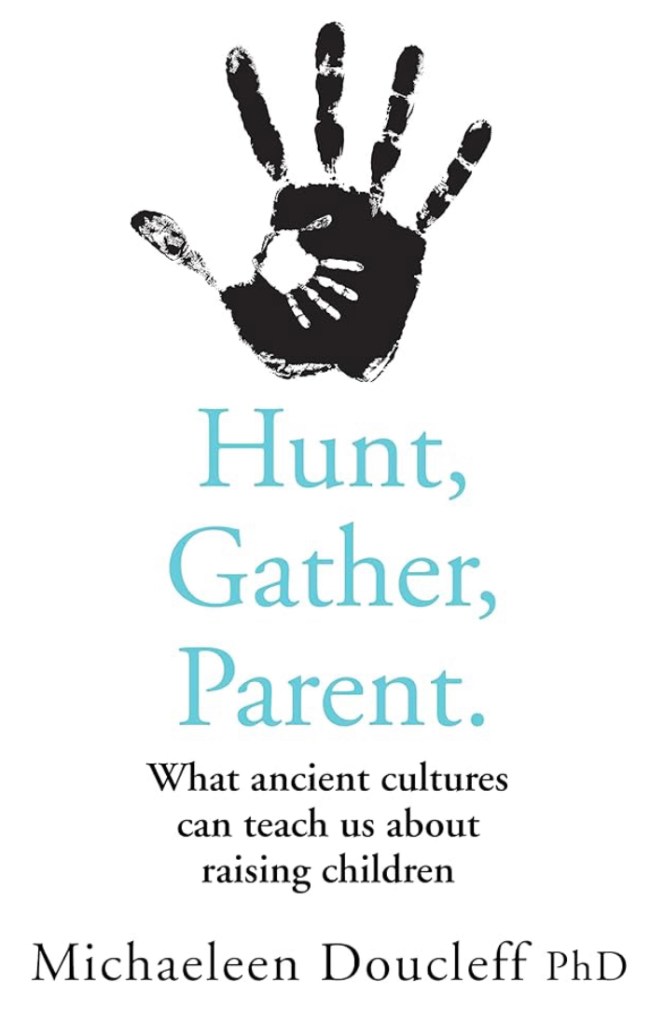
In ‘Hunt, Gather, Parent’ Doucleff, a journalist and mother, embarks on a personal journey to discover why Western parenting practices seem to be falling short. She discovers through her time within the Maya villages in Mexico and Inuit communities in the Arctic, that adopting Indigenous parenting practices feels more intuitive and effective.
Short take: The book introduces us to a range of Indigenous methods in raising kids that prioritise quality time, family, community, and nature. While offering bites of traditional wisdom, some of the strategies offered seem out of step with modern research on child development. I loved the insight this book gave me into Indigenous parenting and think it is a valuable supplement to contemporary parenting approaches.
- Parenting Approach:
- The book advocates for a democratic, community-based approach to parenting, whereby parents, siblings, elders and other non-parental mentors play a role in raising children.
- Doucleff summarises the parenting approach with the acronym TEAM, referring to Togetherness, Encouragement, Autonomy and Minimal Interference.
- Key Themes:
- “Acomedido”. A Spanish term adopted in some Indigenous communities, acomedido refers to the act of paying attention, considering others, and acting helpfully. Doucleff explores how families foster this in children to encourage cooperation, kindness, empathy, gratitude, inclusion of peers, and respect for elders.
- Parenting with calm. Doucleff writes of the importance of taking anger out of interactions with children, never raising one’s voice, and responding to challenging behaviour with patience and empathy. In a similar vein to Buddhist approaches, parents are encouraged to cultivate self-awareness and self-regulation with a range of strategies offered to help parents achieve this (eg. setting realistic and developmentally appropriate expectations, reframing, using social supports).
- Togetherness. The book underscores the importance of spending time together as a family and community in order to foster secure attachment and emotional connection, not just in infancy but throughout a child’s life.
- Encouragement over force. Similar to the approach taken in attachment-based parenting frames, the book endorses encouragement over more authoritarian approaches that aim to control or force a child into compliance. Despite this principle, some of the strategies Doucleff suggests felt to me to be subtly coersive with the goal to forcing a particular outcome. I elaborate on this below.
- Autonomy and Independence: Doucleff examines how Indigenous cultures foster autonomy and independence by giving children responsibilities and freedoms from a young age. They also allow children to roam and play in nature, fostering curiosity, creativity, and a deep connection to the natural world, which in many ways has been lost in the West.
- Community Support: Reflecting the age old expression ‘It takes a village to raise a child’, the book highlights the value of community support and intergenerational relationships in raising kids. Doucleff observes how extended family members and close-knit communities play integral roles in caregiving and providing a supportive environment for children to thrive.
- Learning from Nature: Doucleff documents the range of ways Indigenous communities integrate nature into children’s learning. For instance, observing how plants grow and how animals behave, gathering fruits and vegetables, fishing or weaving. These experiences not only teach children practical skills and responsible environmental stewardship, but also help them develop a personal and enduring relationship with country.
- Overall Impression:
- Weaving personal anecdotes with cross-cultural observations, ‘Hunt, Gather, Parent’ is a valuable resource for parents wanting to integrate elements of traditional wisdom into modern family life.
- The overarching messages make a positive contribution to the vast parenting literature. Principles of togetherness, re-establishing supportive communities, incorporating children into all aspects of family life, and helping parents act calmly and compassionately are just some of the helpful themes explored.
- The role of siblings in a child’s learning is also highlighted and is refreshing coming from a western paradigm where I sometimes find too much emphasis is placed on individuation with a fear of parentifying older siblings. Although parentification is a legitimate concern, this fear can sometimes take away from the beneficial aspects of sibling roles.
- There are a number of useful and practical strategies for parents to try, such as taking children outside when overwhelmed, using facial expressions and body language, and parenting with questions rather than commands. The use of storytelling and play are two other uncontroversially positive strategies. One of the more interesting and novel techniques she suggests is trying to redirect a child’s anger to feelings of gratitude and awe.
- I did feel conflicted by some of the other strategies offered, which seem out of step with modern understandings of child development and parent-child communication. For example, using labels or shaming tactics (eg. calling a child a baby) or unnecessarily evoking fear in a child to get through daily tasks. These perhaps reflect the age of the author’s daughter at the time of writing, as these strategies are unlikely to be effective or beneficial in the longer term. The author also seems to use these tactics with the goal of getting her daughter to comply in some way, which seems counter to her message of ‘encourage, never force’ and is perhaps a western parenting goal to begin with. Finally, using ignoring as a way to deal with misbehaviour can have a place, but can also be an extremely triggering and unhelpful strategy for some children depending on their backgrounds and temperaments, and in my opinion should be used with caution.
- I enjoyed this book and the unique perspective it gave into Indigenous parenting practices. I think that parents who approach the book with a critical lens, do their own further reading, and only adopt strategies that feel intuitive and right to them will gain the most.



 Child Psychology Book Lady
Leave a comment