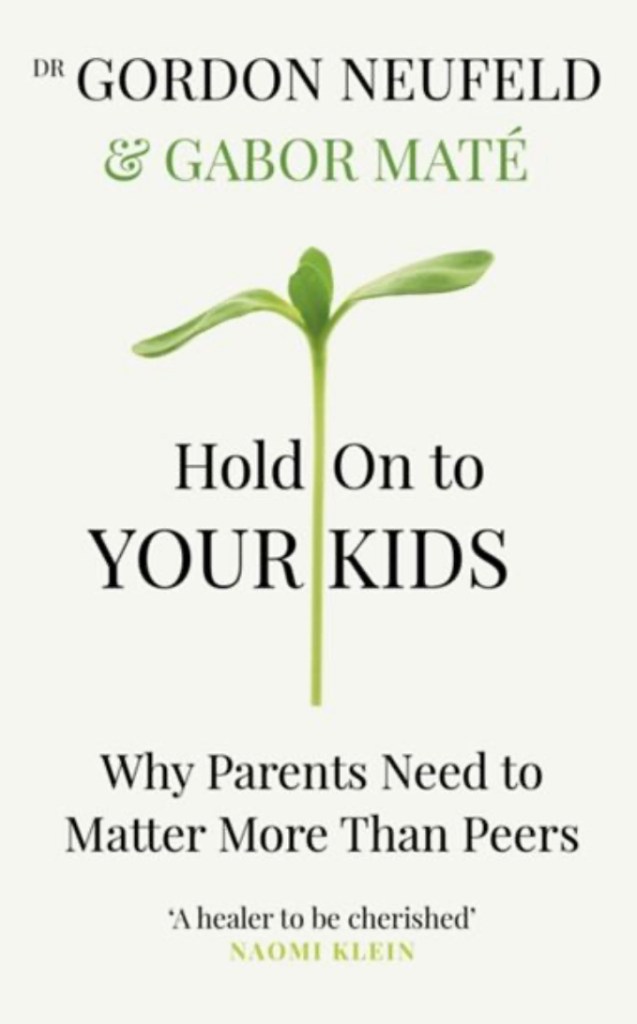
In a world where peer influence seems to dominate, ‘Hold onto Your Kids’ is a book worth reading. Originally published in 2004, the book underscores the importance of parental attachment and challenges prevailing cultural norms that prioritise peer relationships over family bonds.
Short take: The book encourages parents to foster strong connections with their kids, emphasising warmth and responsiveness over control and discipline, and challenges western parenting models that overemphasise individuation and independence. Elements of the book felt overly grim to me and lacking in reassurance and compassion for parents, however, the wisdom offered by the authors makes it a worthy read.
- Parenting approach
- Neufeld and Maté advocate for an attachment-based and democratic parenting approach, emphasising the importance of strong emotional bonds between parents and children.
- Their approach has elements of authoritative parenting, encouraging connection and relationship-building while emphasising that fair and consistent boundaries are important for healthy development.
- Key Themes:
- Parental Attachment vs. Peer Orientation: One of the book’s primary themes is the conflict between attachment to parents versus peers. The authors detail how peer orientation, where children increasingly prioritise the values and views of their peers over their parents, can disrupt the parenting process and lead to problematic behaviours, emotional detachment, and susceptibility to negative peer pressures. By looking to their peers as guides to how they should think or behave, kids are often led astray in a blind leading the blind scenario. This has certainly been my clinical experience working with teens and preteens in therapy, where overemphasis is placed on fitting in, often at the expense of authentic self-expression.
- Negative Consequences from Peer Attachment: peer orientation can lead to negative consequences that affect people throughout their adult lives. Relying too heavily on peer approval can lead to a lack of self-confidence, poor self-esteem and difficulties with decision making. Over comparison with peers may be associated with feelings of inadequacy or competitiveness, as well as emotional instability when inevitable conflicts arise. Risk taking behaviour is also more likely.
- The Role of Society in Parenting: Another central theme of the book is how societal shifts have impacted family dynamics. Neufeld and Maté discuss how changes in society, such as the increased prevalence of both parents working full time outside the home and immense influence of social media, have eroded the traditional roles of parents and empowered peer groups. This is a potentially controversial point, as increased costs of living mean it is often necessary for both parents to work. However, the authors suggest ways to work around these logistical challenges in ways that prioritise the family and child’s primary social system.
- Restoring Parental Influence: The book covers strategies to restore and strengthen parent-child bonds. Techniques such as focusing on warmth and responsiveness, establishing rituals that reinforce connection, and ensuring that parents are the primary source of comfort and guidance are emphasised.
- Overall Impression:
- Neufeld and Mate’s approach offers an alternate to western parenting paradigms that emphasise individuation over continuing family bonds.
- The focus on parental attachment should not be misunderstood as dismissing the role of friends in a child’s life, but rather suggesting that parents should remain a child’s primary guide and mentor well into their teen years.
- I see parallels in the book’s thesis with some Indigenous models of raising kids, as well as the non-mainstream schooling literature. In both cases, attachment to parental and non-parental mentors (eg. elders, relatives) is encouraged, with these people acting as guides for children, thereby reducing the likelihood that they will look horizontally to their peers.
- One of the book’s strengths is its balance between theory and practice. While rooted in attachment theory and developmental psychology, it offers tangible strategies and practical advice for parents. Whether addressing issues of discipline, communication, or fostering resilience, the authors provide steps that can be used to help navigate the complexities of raising kids.
- One element of the book that I found challenging was the lack of focus on self-compassion and helpful reassurance. As a parent reading, I experienced a degree of doom and anxiety about the array of possible negative outcomes for my kids, combined with feeling that some of the solutions offered were insurmountable or unrealistic. This is a reaction that I know has been shared by others while reading the book. Nevertheless, it shouldn’t overshadow how much wisdom the book offers to parenting and raising kids today.
- If you are thinking of reading this book, a question I would ask is: “Do I want my child’s 4, 8 or 14 year old friend to be their guide when making decisions about friendships, body, sexuality, and later drugs or alcohol?” If your answer is no, then this is a book you should read.



 Child Psychology Book Lady
Leave a comment